
Book Review: End of Time Fascism and Perspectives from Central Europe
By Jonáš Syrovátka
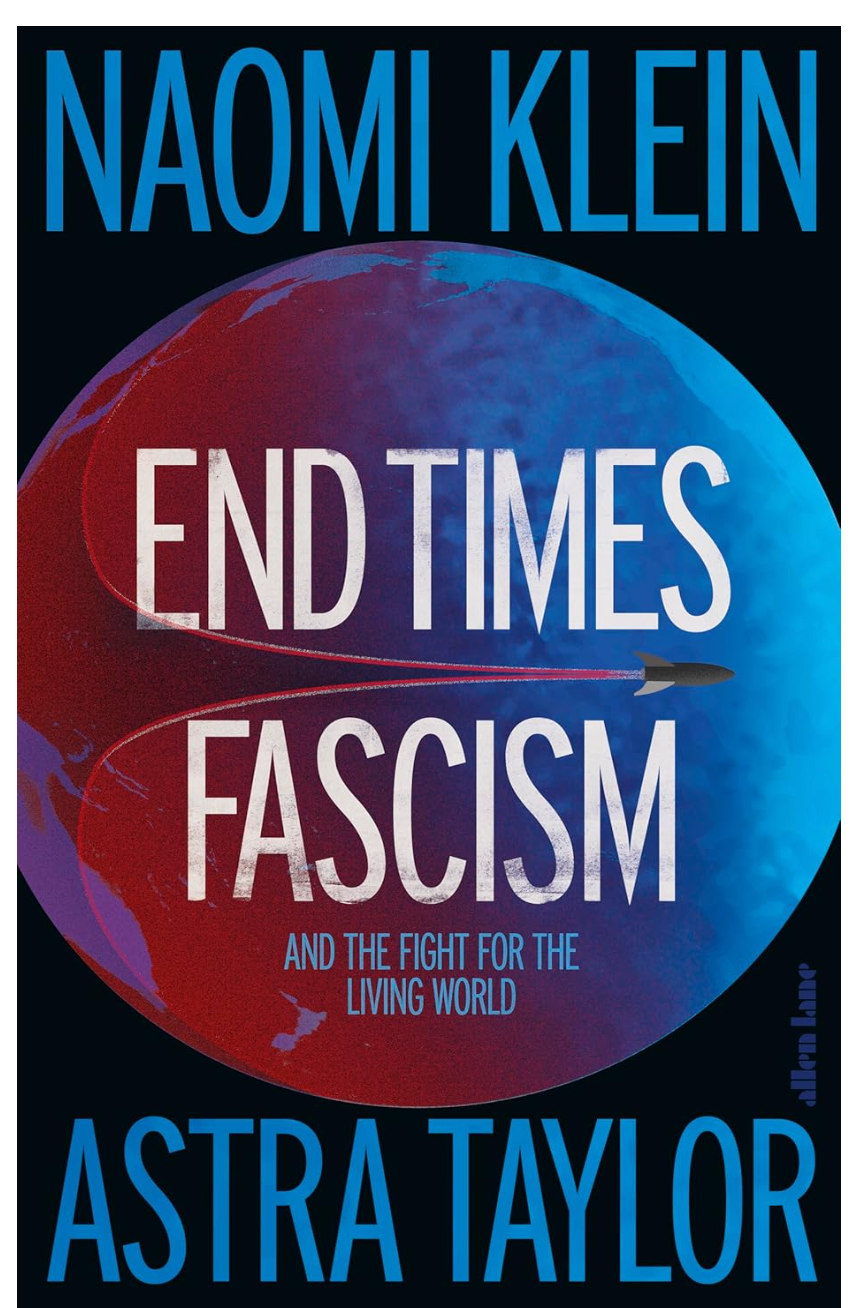
In recent years, a considerable body of books, articles, and other writings has sought to make sense of a rapidly changing world and the resurgence of far-right political movements. Among these is End Times Fascism: And the Fight for the Living World, a book written by journalist Naomi Klein and activist Astra Taylor. The authors pursue two principal aims: first, to examine the ideas, worldview, and political objectives of contemporary far-right actors; and second, to outline a political programme capable of confronting and defeating them. The book thus combines an analysis of contemporary events and political manifesto.
What is End Times Fascism?
The authors label the far-right actors examined in the book as fascists. In their account, fascism is neither confined to the movements of the 1930s Europe nor understood merely as a particular type of political ideology. Rather, the book presents fascism as capitalism’s last line of defence in crisis generated by its own internal contradictions. Fascist ideology, in this view, serves to channel social frustration towards selected scapegoats and to forestall revolutionary sentiments that might otherwise threaten the ruling class. Fascism, therefore, is not understood as a political movement, but as an alliance of politicians, the wealthy, and propagandists. This framing is central to the book, as much of its analysis is devoted to the ideas and objectives of billionaires who have emerged from Silicon Valley over the past two decades.
Moreover, throughout history fascism is an antagonist of emancipation. The authors therefore identify elements of fascism in the forced Christianisation of Spain in the 14th century, European colonialism, slavery in the American South, and the military dictatorships of South America. Fascism is then understood as an ethical principle that privileges sadism and domination over empathy and solidarity. This definition of fascism—which, as noted above, is far from the only possible one—is highly effective for the part of the book intended to function as an appealing political manifesto. At the same time, however, it does little to explain what might attract people to such an ideology, apart from powerful and wealthy people concerned with preserving their privileges or morally depraved individuals. The book pays relatively little attention to the mass appeal of far-right parties, instead presenting their supporters – somewhat sympathetically – as manipulated, frightened, or driven to desperation by economic or social deprivation. In doing so, it sidesteps a much more difficult question: why, in the past, could fascist regimes appear to many people not merely as a plausible form of political order addressing problems of the moment, but generate genuine and even enthusiastic support?
What is supposed to lend a new dynamic to the contemporary form of fascism is the condition of the “end times.” The authors present this as an objective fact, associated above all with the climate crisis. Yet far greater attention is devoted to another development – emergence of artificial intelligence and its profound, potentially destructive consequences for humans and society. In this respect, the authors accurately capture a prevailing social mood marked by uncertainty, anxiety, and unclear expectations surrounding technological changes. At the same time, it will be interesting to see how this perspective will be judged with the benefit of hindsight. At this point, it seems extremely difficult to determine where the honest description of artificial intelligence ends and the fantasies of developers and PR-driven claims designed to attract further investment begin. The sections of the book devoted to this topic may therefore prove either remarkably prescient or, conversely, may date very quickly.
The “end times,” however, are not an objective reality but rather a subjective perception. The fascists described in the book are said to have recognised that the present order is unsustainable and, instead of seeking to address its underlying problems, have begun preparing for an impending period of crisis. And they do so in part through the development of technologies that may themselves accelerate the collapse of society. For their survival they build fortified compounds on remote islands, construct rockets that would enable them to leave the Earth, or they look for ways to upload their own minds to the cloud. The authors describe this approach as a “betrayal of creation” and consequently judge the end times fascists even more harshly than the Nazis. Whereas the latter, in the book’s account, at least felt a sense of obligation towards their own race and sought to improve the living conditions of its members—even at the expense of everyone else—today’s fascists are portrayed as concerned solely with their own individual survival. The authors themselves acknowledge, however, that this extreme position is held by only a small, albeit wealthy and influential, segment of the far-right coalition. Once again, it becomes apparent that the book is above all concerned with billionaires associated with the tech sector.
Three pillars of the fascist alliance (in United States)
The book’s analytical section, which examines the ideologies, objectives, and policies of the far right, lacks a clear structure indicating underlying research approach. It reads instead as a succession of anecdotes, observations, and quotations loosely connected to the central theme. Some quotes would benefit from being placed in a broader context, while other events are described in excessive detail. Although the book’s subtitle suggests a commentary with a global outlook, the overwhelming majority of its examples concern developments in the United States and Israel. Examples from Africa, Asia, and Eastern Europe— apart from Hungary—are almost entirely absent. China, for instance, is mentioned only six times in the whole book. Of course, it would be unreasonable to criticise a book of fewer than 400 pages for failing to address everything, or to fault the authors for seeking to reach—and mobilise—an American readership. Nevertheless, this limited geographical perspective raises the question of how useful the book’s account of the far right is beyond the American context.
The first pillar of the fascist coalition consists of religious fundamentalists who anticipate the imminent end of the world, and of their growing influence over certain governments. In particular, the rise of apocalyptic rhetoric in Israel, used to justify the war in Gaza, should not escape the attention of readers unfamiliar with this region. This section—also discussing the COVID-19 pandemic—is nevertheless only loosely connected to the rest of the book. Some of the included examples of political leaders employing religious rhetoric, moreover, have little to do with any vision of the end times.
By contrast, the chapter tracing the growing influence of Silicon Valley billionaires on American politics and their plans for development of artificial intelligence is considerably more tightly structured. It also follows a clear dramatic arc, beginning with the alliance forged between Donald Trump’s second administration and the captains of the tech industry. The chapter then examines the fruits of this collaboration, including the rollback of regulations, efforts to accelerate the development of artificial intelligence, and plans for the mass construction of data centres with little regard for environmental consequences. It concludes with an account of the surge in grassroots activism that succeeded in halting data-centre construction in Minneapolis.
These developments between 2024 and 2026 seem to be what the authors most wanted to write about. The question of how a political system can respond to technological change, and the rapid emergence of new elites is of central importance to our time. Precisely for that reason, however, it is unfortunate that the book does not devote itself more fully to this subject. There are several potentially fruitful directions such an analysis might have taken. One would be a historical comparison with the regulation of monopolies in the oil industries or in steel production in the United States at the beginning of the twentieth century. Another would be to compare political developments in the United States with those of countries where wealth generated by energy industries became concentrated in the hands of a narrow elite, such as Russia or the Gulf states. These comparisons could reveal illuminating parallels and potentially offer lessons for political action. Alternatively, the authors could have moved beyond the framework of end times fascism and offered a more comprehensive account of the ideas and intellectual influences shaping the thinking of tech billionaires—for example, along the lines of Quinn Slobodian and Ben Tarnoff’s Muskism: A Guide for the Perplexed. By concentrating so heavily on very recent events, however, the book End Times Fascism also runs the risk of seeing its observations age quickly, particularly if political forces less sympathetic to the technology sector gain strength. Such a shift could occur as early as November, following the U.S. congressional elections.
The final pillar of the fascist alliance consists of ethnic nationalists, whose growing influence the authors primarily attribute to fears of mass migration intensified by the climate crisis. This chapter also turns to the European context, notably by discussing the so-called migration crisis of 2015. While this event undoubtedly provided the far right with an important issue around which to mobilise, the book’s account of it is somewhat reductive. For example, the authors suggest that the wealthier parts of Europe refused to accept a fair redistribution of newly arrived migrants. This overlooks the fact that a substantial proportion of Syrian migrants arriving in 2015 headed for Germany, while the proposed relocation quotas became a particularly contentious political issue in the relatively poorer countries of Eastern Europe. Nor can it be denied that political rhetoric towards migrants became considerably less welcoming across the political spectrum. But the claim that centrist politicians in Europe consequently ceded political ground to the far right would require a more thorough analysis than a reference to a single statement by former British Prime Minister Keir Starmer. The book then focuses again on the United States and discusses a broader range of subjects that have not yet been addressed, including the activities of Immigration and Customs Enforcement (ICE), the rise of the manosphere, or the disputes among MAGA influencers following the death of Charlie Kirk.
End Times Anti-fascism
The authors aspire not merely to describe their adversary, but also to propose ways of defeating it. One of their most important sources of inspiration is the campaign of Zohran Mamdani, who became mayor of New York City in November 2025 and to whom the book devotes an entire chapter—perhaps an excessively detailed one. His rhetoric, focused on addressing the city’s concrete problems and at the same time celebrating an inclusive local identity, allows the authors to introduce the concept of “hereness”. The concept draws on the ideas of Jewish social democrats in Tsarist Russia who, at the turn of the twentieth century, organised themselves in the political party Bund. Their response to the predicament of a Jewish people dispersed across the world was neither to await the coming of the Messiah nor to seek the establishment of their own state. Instead, they aimed to achieve social justice for all in the places where their communities lived at the given moment. This way of thinking represents a direct antithesis to the end times fascism, which demands specific territory or privileges to be reserved for a clearly defined group—whether believers, a narrow circle of billionaires, or a nation.
The book does not, however, sufficiently explain to what extent the idea of “hereness” should structure politics. Its ability to provide an ideological framework for civic movements on the local level —illustrated through examples such as the resistance to ICE in American cities and Mamdani’s campaign—is definitely useful. However, the implications of this idea are more radical and could lead to profound change in thinking about political institutions. Based on the logic of “hereness”, one could propose such steps as abolition of nation-states, introduction of direct democracy mechanisms into governance or redistribution of wealth to achieve social justice. But the book does not take advantage of these possibilities and instead uses the concept of “hereness” in a more limited way as an appealing yet shallow ideological branding. This seems like a missed opportunity to propose an ideologically coherent answer to end time fascism.
When the book proposes concrete political prescriptions it adopts the rhetoric of the end times, suggesting that we are one step away from achieving a post-capitalist world that will be “deeply democratic, socialist, feminist, multiracial, multispecies, internationalist, generous, courageous, and animate.” But then its relatively moderate suggestions focus primarily on curbing the power of a new class of the extremely wealthy through measures such as higher taxation, regulation or nationalisation of artificial intelligence, and strengthening international law. This creates a certain tension between the scale of the envisioned changes and the specific steps proposed to achieve them.
Central European Perspective
Criticising a book for what it does not include can be somewhat unfair, since it is ultimately the authors’ prerogative to decide what they want to write about. On the other hand, the concept of end times fascism is presented as a universal framework, while the book is described by the publisher as a “blistering reckoning with our age.” However, it would be more accurate to say that the book is a reckoning with the past two years of American politics. That is by no means uninteresting, but for someone living in Central Europe, it falls well short of addressing some of the questions of crucial importance for politics in the region.
The book largely leaves the war in Ukraine – an event of fundamental importance to European security – out of its analysis. Yet the origins of the war cannot be understood without considering the erosion of American hegemony in the international order. The effects of this shift in world affairs might not manifest themselves so dramatically at the centres of power, but in peripheral regions — such as Central Europe – they will inevitably lead to greater instability. The book contains an interesting anecdote about the appeal made by the U.S. government in the 1960s for citizens to build private shelters in preparation for a nuclear conflict. Refusing to heed this advice is presented as a mature moral gesture, expressing an unwillingness to barricade oneself against one’s fellow citizens in times of crisis. One can only wish that the inhabitants of Kyiv, subjected to daily bombardment, could afford to approach the question of shelters according to such criteria alone. Any serious discussion of politics in Central Europe in the 21st century must be accompanied by realistic proposals for maintaining peace and security. Unwillingness to seriously engage with this topic leaves the door open for the far-right forces that thrive on instability and a sense of insecurity.
The book also makes scarcely any mention of the European Union (occasionally using the word “Europe” as a substitute for the organisation). Yet for the small and medium-size states of Central Europe, the EU is precisely the institution that represents their interests on the global stage. The institution is undoubtedly imperfect and, in many respects, ill-prepared for the challenges of the 21st century. That, however, should not lead to resignation, but rather to efforts to reform and strengthen it. Thinkers in Central Europe should arguably be prioritising the debate about how to achieve that, given the immediate challenges facing the region. For that reason, it may ultimately prove more useful to devote greater attention to books addressing this topic rather than to those primarily concerned with political developments on the other side of the Atlantic.
Jonáš Syrovátka is a postdoctoral researcher at Charles University in Prague, Czech Republic, focusing on the ideology of far-right movements, security and propaganda.
Invest in independent media research and join a community of practice.
MJRC takes no government money — so the questions we chase are set by the field, not by a funder. A contribution keeps our research and global analysis independent, and buys you a seat closer to the work: early access to new findings, invitations to small-group briefings, a place in our Supporters Circle, and the option to be listed on our Supporters Page.