
New Study Finds European Climate Coverage Turns On Sovereignty, Not Science
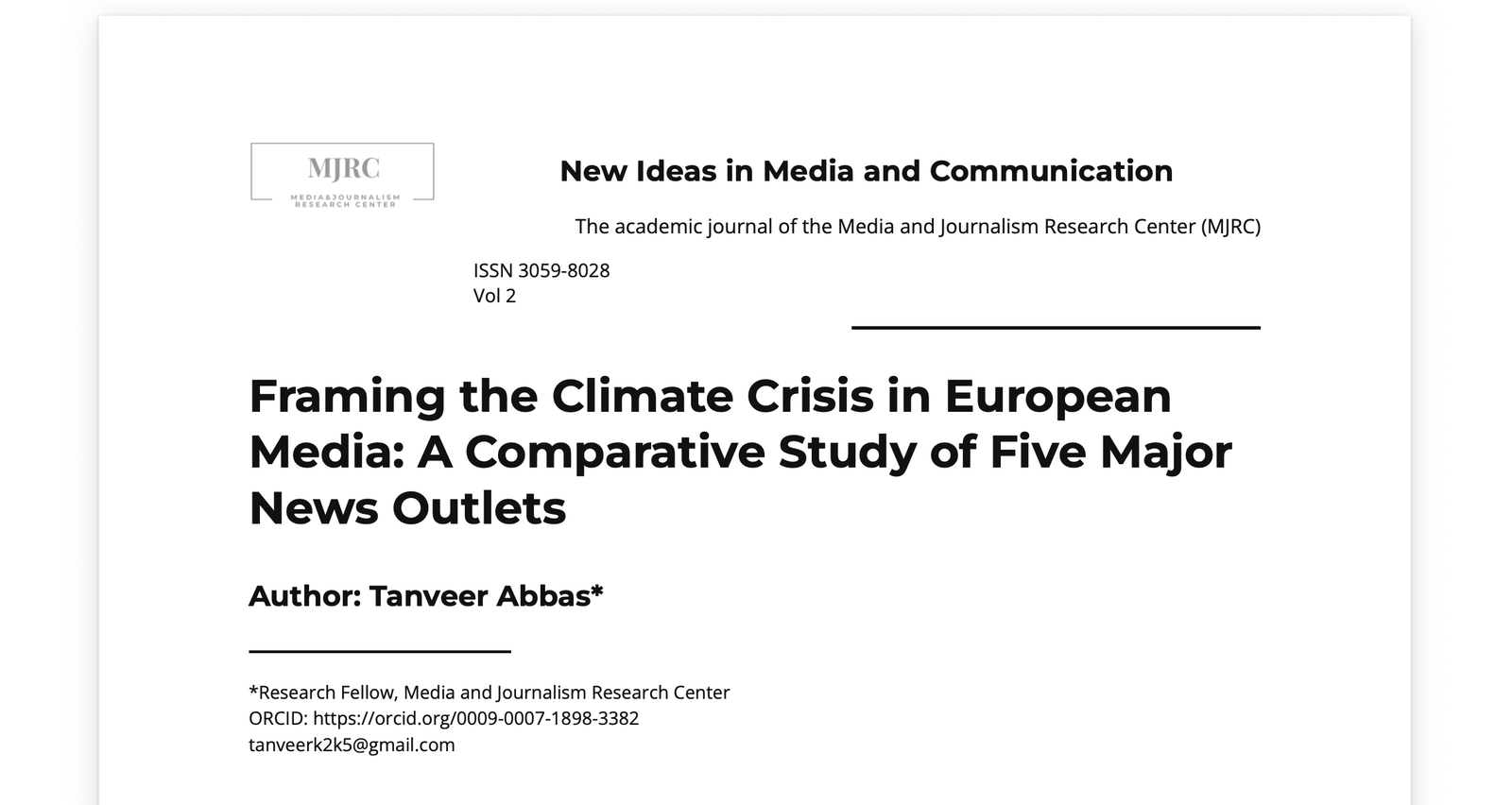
A new article published in New Ideas in Media and Communication, the academic journal of the Media and Journalism Research Center, finds that national sovereignty, not scientific urgency, is the single most common way five of Europe’s leading newspapers framed climate change between 2022 and 2025.
In Framing the Climate Crisis in European Media: A Comparative Study of Five Major News Outlets, MJRC research fellow Tanveer Abbas analyses 112 articles from Der Spiegel, Le Monde, La Repubblica, Gazeta Wyborcza and El País. Sovereignty framing leads in 39 of them, ahead of scientific urgency in 29. It is the dominant frame in the German, French and Italian outlets alike, a pattern that cuts across the usual north-west/south-east divide in European media research.
The study’s central contribution is conceptual. Abbas proposes the Energy Security Bridge-Delay Framework, which separates three very different uses of the same energy-security language: Bridge framing ties strategic autonomy to renewable expansion and speeds decarbonisation. Transitional framing accepts a short-term fossil-fuel compromise but specifies a credible endpoint. Delay framing invokes security and cost to postpone action indefinitely, without any exit timetable.
Applied to a 21-article close-reading sub-sample, the framework finds delay-oriented arguments the most common of the three, in eight cases against six bridge and five transitional. The distinction matters, Abbas argues, because treating all energy-security talk as a single frame obscures politically consequential differences in whether climate action is enabled, bounded or deferred.
The article closes with a three-question editorial audit that journalists and editors can apply directly: does an energy-security argument specify a credible endpoint; does it link security to low-carbon supply or to continued fossil dependence; and does it assign responsibility and a timetable, or defer to unspecified future actors and technologies?
The full corpus, including every coded article and the screening audit trail, is published alongside the paper as a supplementary file.
The article is available in full, free of charge, on the New Ideas in Media and Communication journal page. MJRC charges neither authors nor readers.
Invest in independent media research and join a community of practice.
MJRC takes no government money — so the questions we chase are set by the field, not by a funder. A contribution keeps our research and global analysis independent, and buys you a seat closer to the work: early access to new findings, invitations to small-group briefings, a place in our Supporters Circle, and the option to be listed on our Supporters Page.