
New Study Proposes an Audit Protocol for AI-Mediated Communication
The Media and Journalism Research Center has published a new article in its journal New Ideas in Media and Communication, proposing a framework for analysing communication in which meaning is produced jointly by people, organisations and generative AI systems.
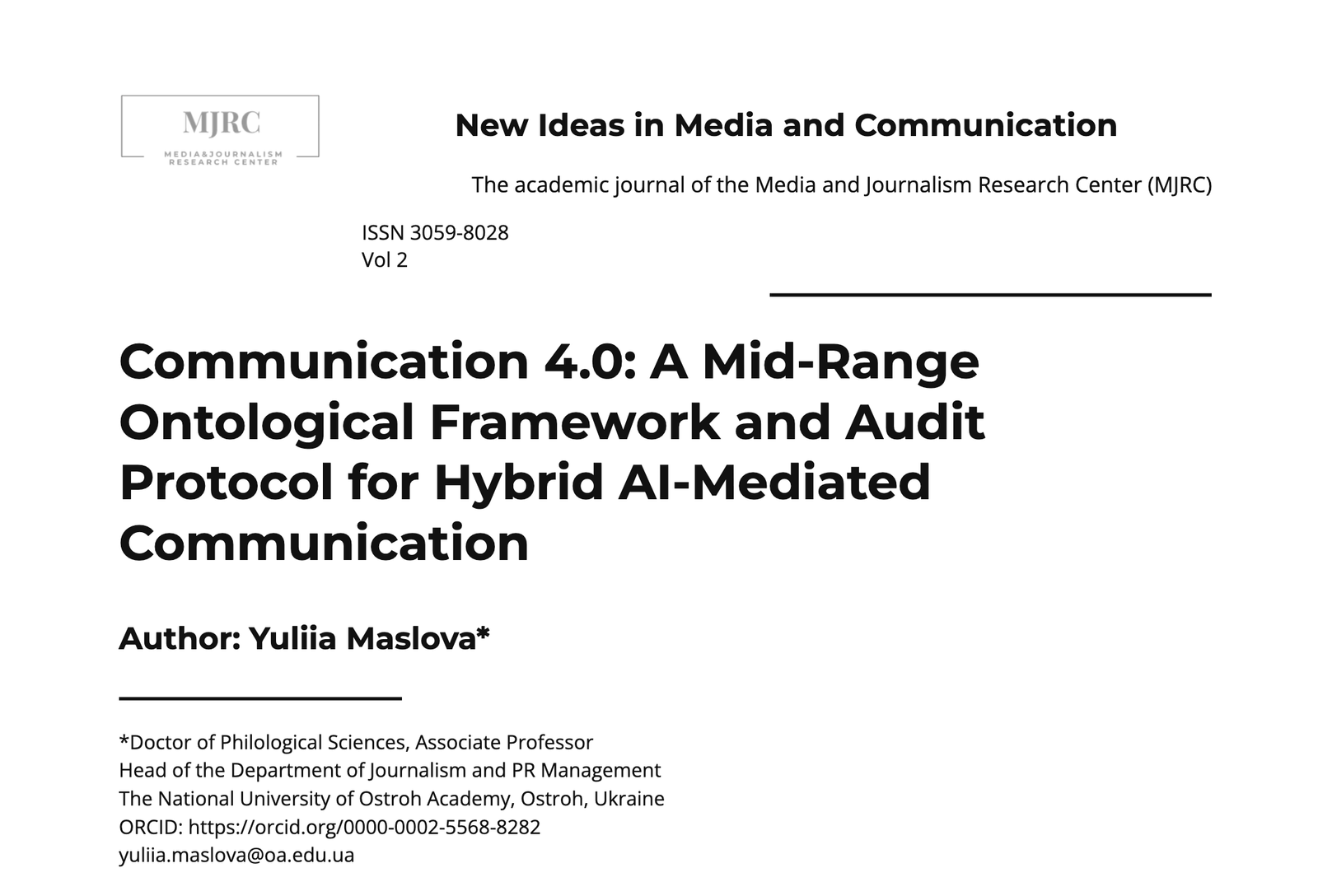
In Communication 4.0: A Mid-Range Ontological Framework and Audit Protocol for Hybrid AI-Mediated Communication, Yuliia Maslova of The National University of Ostroh Academy in Ukraine argues that generative AI does more than add a channel to communication. In some workflows it selects sources, generates language, reorganises evidence and ranks what becomes visible, feeding its own earlier outputs back into later stages.
Maslova’s central claim is an asymmetry: semantic participation may be distributed across humans, machines and infrastructures, but legal, professional and moral accountability remains attributable to human and organisational actors. Computational systems can be constitutive of what a message means without becoming answerable for it.
The framework is translated into an Ontological Communication Audit, a six-dimension protocol that reconstructs who did what, in what order, under whose authority, and how an output can be corrected or contested. Maslova applies it to the 2025 “Heat Index” case, in which an AI-assisted summer reading list containing fabricated books passed through a freelancer, a syndicator and two newspapers before readers caught it. The audit shows how the fabrication acquired institutional credibility at each stage, and why correction could not fully undo circulation.
The article closes with practical requirements for newsrooms: keep proportionate records of consequential AI transformations, match verification to the specific function AI performed rather than issuing a generic disclosure, and ensure every consequential output has an identifiable route to authorisation and remedy.
The article is open access and available to read in full.
Invest in independent media research and join a community of practice.
MJRC takes no government money — so the questions we chase are set by the field, not by a funder. A contribution keeps our research and global analysis independent, and buys you a seat closer to the work: early access to new findings, invitations to small-group briefings, a place in our Supporters Circle, and the option to be listed on our Supporters Page.