
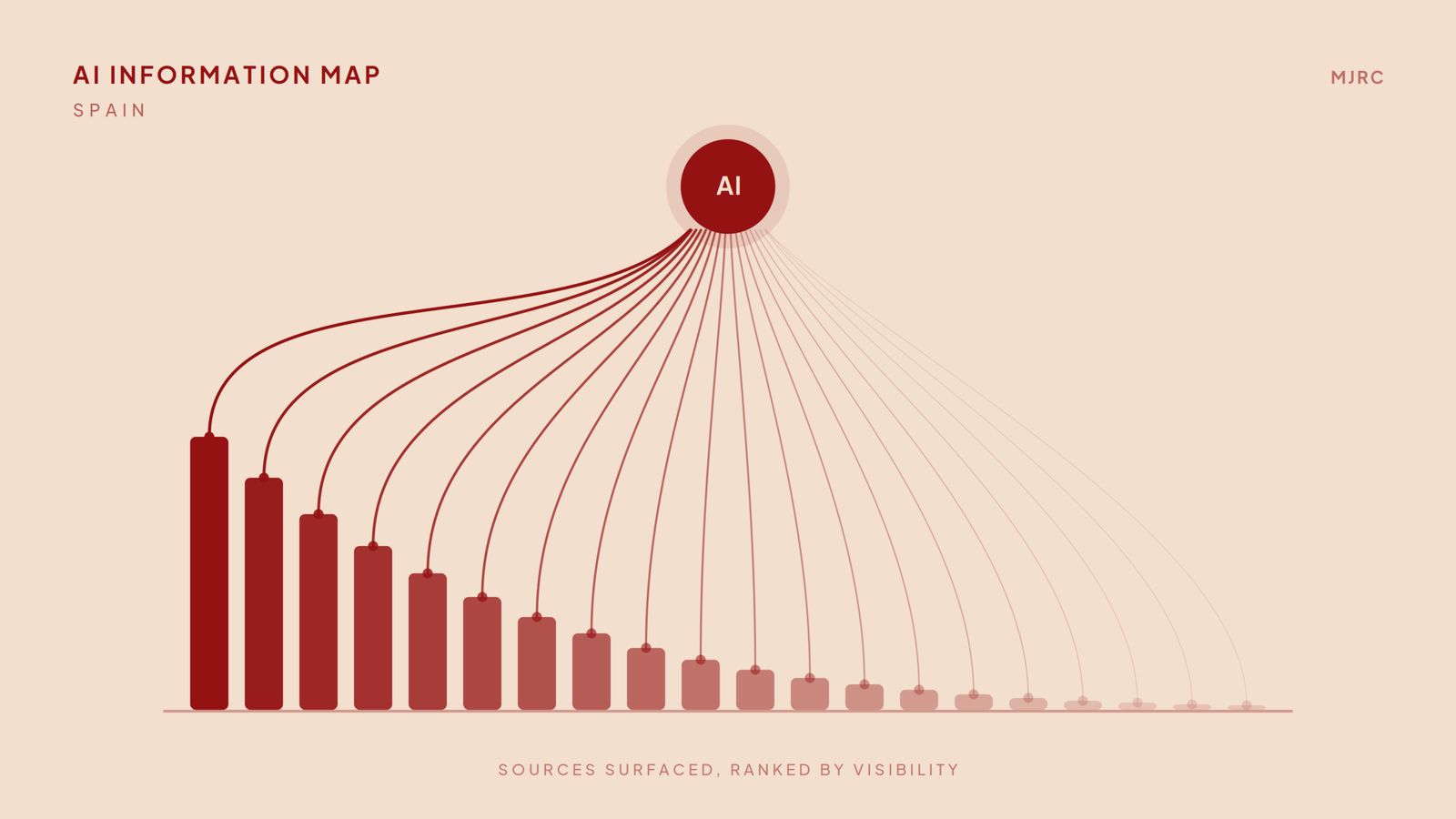
AI Information Map Spain Released: What Sources AI Systems Pick When They Describe Spain
The Media and Journalism Research Center (MJRC) has published the Spain results from its AI Information Map, a research project that tracks which sources artificial intelligence systems make visible, recommend, or warn against when people ask them about news and public affairs.
The Spain edition follows the publication of the Romania results and is part of a broader country-by-country mapping effort that will continue with further national editions.
The Spain batch tested ten major AI systems (Perplexity, ChatGPT, Gemini, Copilot, Claude, DeepSeek, Meta AI, Grok, Mistral’s Le Chat and Google AI Overviews) in their free versions, asking comparable questions in both English and Spanish. The findings map the sources behind roughly 400,000 archived answers.
The headline finding is mixed. No single Spanish outlet dominates the AI information layer. El País, the most visible source, accounts for just 4.9% of citations, while more than three quarters of all visibility is spread across 1,924 further sources. By the standards of search and recommendation systems, that is a strikingly wide field.
But the top of that field raises sharper questions. Behind El País come Wikipedia, Cadena SER, La Moncloa, Reuters and the European Commission. Spanish journalism is present, but it often sits behind reference works, official communication and institutional sources in the queue of what AI systems reach for first.
Language changes the picture. Asked in English, the systems lean more heavily on governments, agencies, international bodies and English-language explainers. Asked in Spanish, they turn more readily to Spanish newsrooms. The same question can therefore produce a different Spain depending on the language in which it is asked.
The study also examined which sources the systems recommend as reliable and which they advise users to treat with caution. El País, RTVE, La Vanguardia, El Correo and El Mundo appear prominently among recommended outlets. No Spanish source was labelled as disinformation by any assistant. The harshest category used was caution, with warnings aimed at combative digital titles, platforms and, unexpectedly, RTVE.
The RTVE case receives special attention in the Spain profile. The public service broadcaster is both the second most recommended Spanish outlet and the second most warned-about source, showing how AI systems can reproduce unresolved debates about media independence without explaining the contradiction to users.
The Spain results are published as a browsable set of findings, alongside the methodology and an in-focus profile of RTVE. The AI Information Map is designed as a growing database, with figures updated as new collection rounds are added and more country editions are published.
See the full Spain results on the AI Information Map: Spain.
See the Romania edition here.
See the AI Information Map project page here.