
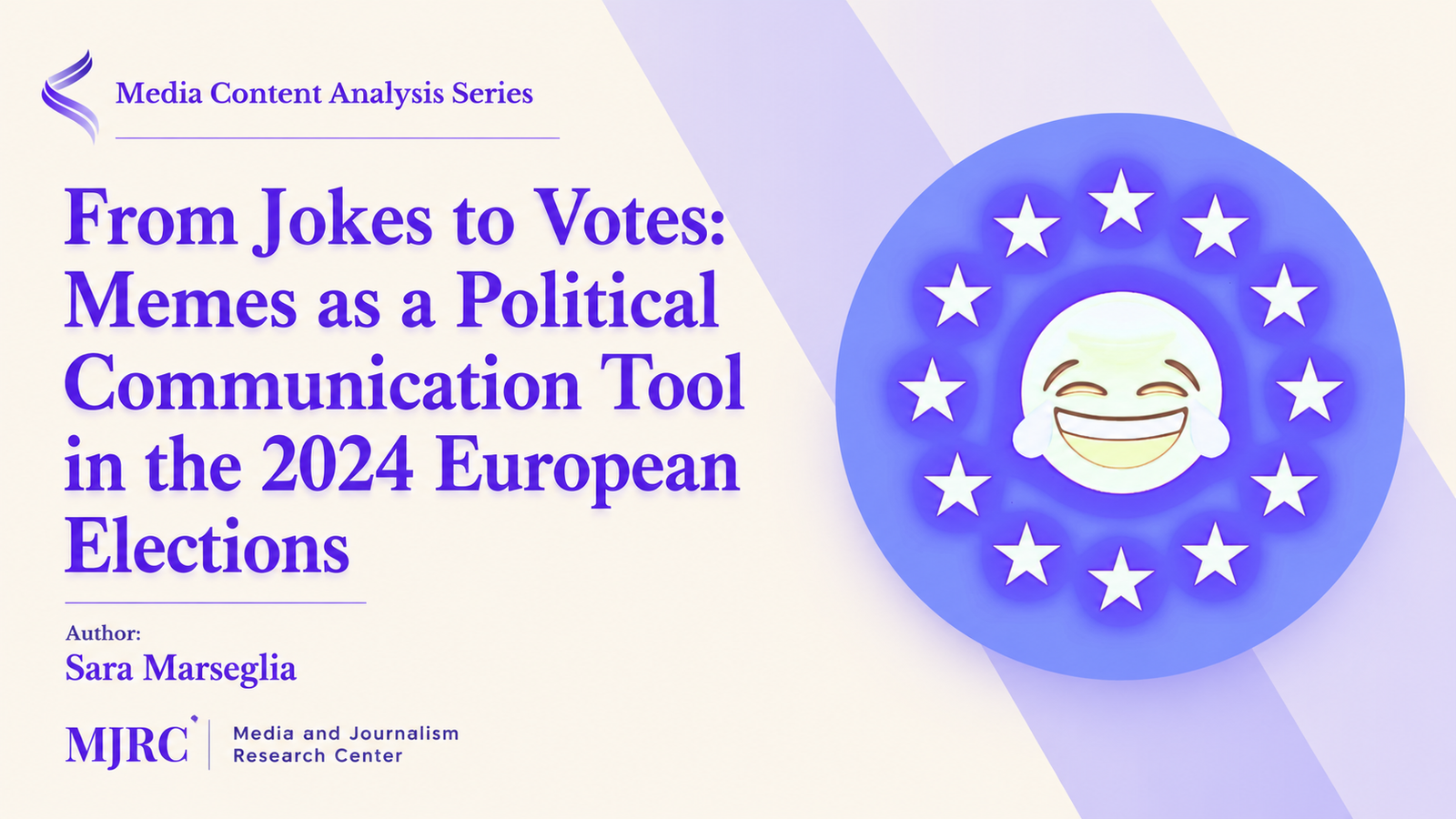
New MJRC Study Explores the Political Power of Memes in the 2024 European Elections
The Media and Journalism Research Center (MJRC) has published a new study examining how political memes were used during the 2024 European Parliament elections, highlighting their growing role as tools of attack, identity-building and digital mobilisation.
The study, From Jokes to Votes: Memes as a Political Communication Tool in the 2024 European Elections, was written by Sara Marseglia, a Media Studies student and journalist with a background in Political Science, as part of MJRC’s Young Researchers Program. The report forms part of MJRC’s Media Content Analysis Series, a research portfolio dedicated to examining media output, political framing, bias, visibility trends and communication patterns across platforms and countries.
Read the study here.
Access the project page here.
Focusing on the final month of the European election campaign, the study analysed Instagram and TikTok posts published by the three highest-vote parties in Italy, Spain, Germany and France. It also examined a smaller sample of politically relevant influencers and influencer-like media figures in the same countries. Across 1,752 party posts, the study identified 62 memes; a parallel influencer dataset of 147 posts produced only nine memes, all from one Spanish influencer.
The findings suggest that meme-posting was selective rather than pervasive, but politically revealing. It was concentrated mainly among right-of-centre, right-wing and far-right parties. The study found that memes were used largely for negative campaigning, ridicule and delegitimisation of opponents, with irony far more common than straightforward humour. Most of the memes analysed did not address European Union issues directly, despite the electoral context, suggesting that even in European elections, memes often remain nationally anchored political artefacts.
A key contribution of the study is its discussion of what Marseglia calls a broader “memetic attitude” among political influencers. Rather than simply posting identifiable memes, some political figures appear to adopt a style of communication shaped by humour, exaggeration, self-reference and cultural recognition.
For MJRC, the study expands its work on platform-native political communication and digital campaigning, showing how visual culture, social media logic and political messaging increasingly overlap. It also points to an important next step for research: understanding how grassroots users, not only parties or influencers, drive the wider “meme war” of contemporary politics.
Invest in independent media research and join a community of practice.
MJRC takes no government money — so the questions we chase are set by the field, not by a funder. A contribution keeps our research and global analysis independent, and buys you a seat closer to the work: early access to new findings, invitations to small-group briefings, a place in our Supporters Circle, and the option to be listed on our Supporters Page.